BRA RFP Bartlett Yard.pdf
Hey guys,
Here is the RFP that I found for Bartlett Yard. The section called Development Goals might be useful to us!
Christine
Wednesday, February 29, 2012

Tuesday, February 28, 2012
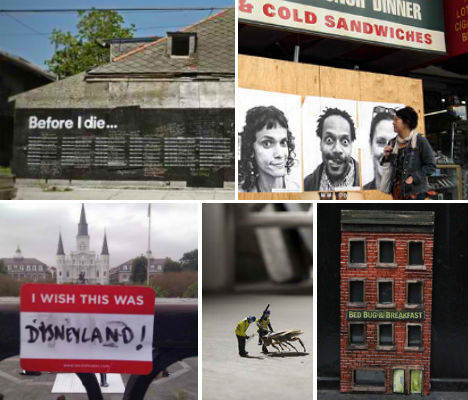
Interactive Urbanism: 5 Simple Street Art Projects
Good Work
All-
Great work to date. I for one am really super excited about our direction. We've given you a lot of work to do for the next two weeks but make sure you're having fun!
I just did a quick look on google street view, and have some observations:
1) The site is definitely NOT flat. Make sure the topography is accurate! Lisa, this is also your sphere for analysis - if I were you I'd immediately be analyzing the 3d model and topographic survey to understand water runoff and drainage. Water management could be a significant driver of form in this project, especially given the potential agricultural component.
2) there's a community garden very close. in street view there's actually a farmers market sign on the corner i'm sure you're all aware of this...
3) I know the other site was also interesting, but i think this was a great choice.
-dan
Great work to date. I for one am really super excited about our direction. We've given you a lot of work to do for the next two weeks but make sure you're having fun!
I just did a quick look on google street view, and have some observations:
1) The site is definitely NOT flat. Make sure the topography is accurate! Lisa, this is also your sphere for analysis - if I were you I'd immediately be analyzing the 3d model and topographic survey to understand water runoff and drainage. Water management could be a significant driver of form in this project, especially given the potential agricultural component.
2) there's a community garden very close. in street view there's actually a farmers market sign on the corner i'm sure you're all aware of this...
3) I know the other site was also interesting, but i think this was a great choice.
-dan
Saturday, February 25, 2012

Thursday, February 23, 2012
HELP!
Hey everyone,
I'm struggling with creating a line in Illustrator, and the tutorials are a bit confusing. For some reason when I draw a line with the pen tool it extends to both sides of the point that I am clicking on. Then when I go to draw a second line, I get some crazy shape that looks like I'm using the spline tool in autocad. Anybody have any idea what I'm doing wrong?
Thanks,
Christine
I'm struggling with creating a line in Illustrator, and the tutorials are a bit confusing. For some reason when I draw a line with the pen tool it extends to both sides of the point that I am clicking on. Then when I go to draw a second line, I get some crazy shape that looks like I'm using the spline tool in autocad. Anybody have any idea what I'm doing wrong?
Thanks,
Christine
Tuesday, February 21, 2012
Information is Beautiful
All-
Some more great visual info websites:
http://www.informationisbeautiful.net/
http://www.guardian.co.uk/news/datablog
Some more great visual info websites:
http://www.informationisbeautiful.net/
http://www.guardian.co.uk/news/datablog
Monday, February 20, 2012
30-day free trial
Hey guys,
Went to school today to work on Illustrator. Not open!! :(
For those of you who don't have illustrator on their home computers like me. I found this.
30 day free trial
http://www.adobe.com/cfusion/tdrc/index.cfm?product=illustrator
Happy Illustrating!! :)
Christine
Went to school today to work on Illustrator. Not open!! :(
For those of you who don't have illustrator on their home computers like me. I found this.
30 day free trial
http://www.adobe.com/cfusion/tdrc/index.cfm?product=illustrator
Happy Illustrating!! :)
Christine
Saturday, February 18, 2012
Friday, February 17, 2012
Thursday, February 16, 2012
Benefits of buying local food.
http://food-hub.org/files/resources/Food%20Miles.pdf
Hey guys,
I found this article about the benefits of buying food locally on health and the environment and thought it was super interesting. The best are the last two pages with statistics and studies on health. It's only four pages, but pretty amazing. It's interesting because I think it is also valid when we're talking about the effects of using local materials in our designs vs. importing materials that are "inexpensive".
When we were talking on Tuesday about pre-fab vs. local it was said that it doesn't matter, whatever is inexpensive. But I think that "inexpensive" needs to be defined as something more than monetary value. Because importing "cost effective" materials, can costs us all a lot more than just money. It cost us additional pollution, it costs us the improvement of local economies, it costs us local knowledge that could be on the verge of dying out. I think the idea that each material or food that we consume has a much longer lifestyle that we all know exists, but choose to ignore, is a big problem.
Hey guys,
I found this article about the benefits of buying food locally on health and the environment and thought it was super interesting. The best are the last two pages with statistics and studies on health. It's only four pages, but pretty amazing. It's interesting because I think it is also valid when we're talking about the effects of using local materials in our designs vs. importing materials that are "inexpensive".
When we were talking on Tuesday about pre-fab vs. local it was said that it doesn't matter, whatever is inexpensive. But I think that "inexpensive" needs to be defined as something more than monetary value. Because importing "cost effective" materials, can costs us all a lot more than just money. It cost us additional pollution, it costs us the improvement of local economies, it costs us local knowledge that could be on the verge of dying out. I think the idea that each material or food that we consume has a much longer lifestyle that we all know exists, but choose to ignore, is a big problem.
Wednesday, February 15, 2012
Housing and the 99%
This is a good article that I thought relates to some of our discussions about the state of housing, and its accessibility. (There is even a mention of Bucky Fuller!)
http://places.designobserver.com/feature/housing-and-the-99-percent/32308/
Tuesday, February 14, 2012
Pecha Kucha
I just learned about PechaKucha and I think we should try it out for our next pin up. The format is to present 20 slides, each lasting 20 seconds. The slides forward automatically and you talk to the slides as they run. Considering all our stuff for monday is going to be digital it would work great.
here's a link for more info about PechaKucha:
http://www.pecha-kucha.org/what
here's a link for more info about PechaKucha:
http://www.pecha-kucha.org/what
YouthBuild Boston
All-
Something to be aware of as you begin research: http://www.youthbuildboston.org/
Aviva and I are meeting later and following up on some contacts. we will be in touch on any tangible directions!
Great work yesterday.
Something to be aware of as you begin research: http://www.youthbuildboston.org/
Aviva and I are meeting later and following up on some contacts. we will be in touch on any tangible directions!
Great work yesterday.

Monday, February 13, 2012

Saturday, February 11, 2012
Hey everyone,
I've never used a blog before, so I'm still kind of learning how this whole thing works on the fly. Let me know if I messed something up and you can't see the image I'm posting.
This
is the first page, for the most part complete. Please let me know what
you all think! I'm still working on a 3D SketchUp Model, and my
reconstruction of the Aquaponics Diagram, along with a model.
Thanks everyone!


Friday, February 10, 2012
Exhibit: InForm
This is a exhibit that just opened today at the new BSA gallery. I haven't seen it yet but I thought it could be pertinent to the class.
http://bsaspace.org/exhibits/in-form/
http://bsaspace.org/exhibits/in-form/
Wednesday, February 8, 2012
Video relating to Week 2 Reading
Came across this video that articulates a lot of the ideas brought up in last week's reading.
Week 2 Reading Discussion
Reading: DESIGN WITH THE OTHER 90%: CITIES - Cynthia E. Smith; SOCIAL URBANISM - Alejandro Echeverri; and THE ORDER OF THE AMERICAN CITY: ANALYTIC DRAWINGS OF BOSTON - Mario Gandelsonas
These readings are chiefly concerned with examining design solutions that address coping with rapid urban expansion. Smith and Echeverri specifically examine the informal city, areas that expand at a greater rate than supporting infrastructure development, while Gandelsonas provides graphical analysis of the ordering systems in place of a 'formal' city structure: Boston.
How do we deal with rapid expansion (population and population density)? To what degree do design interventions assuage our cities' social problems resulting from rapid population expansion? To what degree do these interventions create/perpetuate these same problems?
Gandelsonas would argue that Boston provides an excellent example of how a city can address areas of high density by implementing expansion joints at the urban scale to accommodate relatively unpredictable growth. His drawings of the radial grids seen in the 'neck' of Boston provide an ordering system that allows for infinite expansion along grid guidelines yet still conform to the radial ordering of the city (which addresses the historical informal urban expansion initiated from the city's birth). The design intervention at the heart of Boston's urban ordering system is transportation infrastructure. Roads, highways, rail systems, waterways and the civil infrastructural supporting these systems enable reliable access across the city and positions Boston to accommodate urban expansion because this infrastructure datum allows city planners to predict with relative accuracy where expansion occurs and how direct resources to support expansion.
Should we accept Gandelsonas' argument that transportation infrastructure is the most effective means for urban organization and order? His graphical analysis strongly links building design and building characteristics, and even urban expansion, as dependent to transportation infrastructure (whether it be waterways, underground rail, highway, main road or side street). This makes sense in a city with heavy reliance on automotive power and the resources to support and operate a broad spectrum of transportation infrastructure, but how does this apply to a city without access to these resources?
Smith suggests that the most effective means of coping with rapid urban expansion seen in informal cities isn't necessarily built projects, instead it is flexible policy. Instead of these impoverished communities relying solely on government resource allocation, city and federal governments create flexible policies aimed at legitimizing solutions derived within these impoverishment areas. More specifically, allowing non-government groups (frequently foreign) to act within these environments to bring resources, raise funding for construction projects and raise international support per localized circumstance. This pro-globalization stance brings us to a very interesting arrival: If the world's poorest urban communities are being formalized by international firms, should there be an international model for addressing informal cities? This would theoretically undercut the influence local communities have over legitimizing improvised solutions, and basically renders Smith's argument a paradox. This situation would only arise if there is substantial investment in global organizations operating in informal cities, though is it possible any real improvement in these areas is possible without major intervention?
Echeverri's argument offers a possible solution: Educational infrastructure governed and organized organically, with the capacity to reach out to the global institutions for resources, will empower communities to better understand and cope to their urban plight.
The question still remains: How do we (as a local urban planner) address rapid population growth? How does this change from a global perspective?
These readings are chiefly concerned with examining design solutions that address coping with rapid urban expansion. Smith and Echeverri specifically examine the informal city, areas that expand at a greater rate than supporting infrastructure development, while Gandelsonas provides graphical analysis of the ordering systems in place of a 'formal' city structure: Boston.
How do we deal with rapid expansion (population and population density)? To what degree do design interventions assuage our cities' social problems resulting from rapid population expansion? To what degree do these interventions create/perpetuate these same problems?
Gandelsonas would argue that Boston provides an excellent example of how a city can address areas of high density by implementing expansion joints at the urban scale to accommodate relatively unpredictable growth. His drawings of the radial grids seen in the 'neck' of Boston provide an ordering system that allows for infinite expansion along grid guidelines yet still conform to the radial ordering of the city (which addresses the historical informal urban expansion initiated from the city's birth). The design intervention at the heart of Boston's urban ordering system is transportation infrastructure. Roads, highways, rail systems, waterways and the civil infrastructural supporting these systems enable reliable access across the city and positions Boston to accommodate urban expansion because this infrastructure datum allows city planners to predict with relative accuracy where expansion occurs and how direct resources to support expansion.
Should we accept Gandelsonas' argument that transportation infrastructure is the most effective means for urban organization and order? His graphical analysis strongly links building design and building characteristics, and even urban expansion, as dependent to transportation infrastructure (whether it be waterways, underground rail, highway, main road or side street). This makes sense in a city with heavy reliance on automotive power and the resources to support and operate a broad spectrum of transportation infrastructure, but how does this apply to a city without access to these resources?
Smith suggests that the most effective means of coping with rapid urban expansion seen in informal cities isn't necessarily built projects, instead it is flexible policy. Instead of these impoverished communities relying solely on government resource allocation, city and federal governments create flexible policies aimed at legitimizing solutions derived within these impoverishment areas. More specifically, allowing non-government groups (frequently foreign) to act within these environments to bring resources, raise funding for construction projects and raise international support per localized circumstance. This pro-globalization stance brings us to a very interesting arrival: If the world's poorest urban communities are being formalized by international firms, should there be an international model for addressing informal cities? This would theoretically undercut the influence local communities have over legitimizing improvised solutions, and basically renders Smith's argument a paradox. This situation would only arise if there is substantial investment in global organizations operating in informal cities, though is it possible any real improvement in these areas is possible without major intervention?
Echeverri's argument offers a possible solution: Educational infrastructure governed and organized organically, with the capacity to reach out to the global institutions for resources, will empower communities to better understand and cope to their urban plight.
The question still remains: How do we (as a local urban planner) address rapid population growth? How does this change from a global perspective?
Tuesday, February 7, 2012
No need to panic, its art
I saw this link this morning and it reminded me of our first project.
http://news.yahoo.com/photos/no-need-to-panic-it-s-art-1328228700-slideshow/
http://news.yahoo.com/photos/no-need-to-panic-it-s-art-1328228700-slideshow/
Monday, February 6, 2012

Saturday, February 4, 2012
Cool Book
A book that I feel reflects the A2 project, as well as some
of the topics I imagine we will be talking about in the future is “shop class
as soul craft” by Matthew Crawford. The book really hits on some topics that I feel
are really important to the future of architecture like the lack of connection
to crafts/trades/the material world and the movement towards more thinking than
actual doing. Check it out, and if any of you would like to borrow it, let me
know.
Friday, February 3, 2012
More Socially-Engaged Architecture Articles!

Subscribe to:
Posts (Atom)