In response to your reading of David Harvey's Spaces of Insurgency and Henri Lefebvre's Right to the City, think about and respond to these questions:
1. Why does Harvey create this argument with the political and the personal at either end?
2. What is harvey's idea of the architect / planner's role? How does it differ from Lefebvre's?
3. What is Utopia?
4. How is utopian thinking useful for us? For a construction training school?
5. Why think about architecture, or community, or the urban as process rather than object?
6. What is the role of the 'institution'?
Monday, January 30, 2012

Project A2: CASE STUDY

“Case studies are analyses of persons, events, decisions, periods, projects, policies, institutions, or other systems that are studied holistically by one or more methods. The case that is the subject of the inquiry will be an instance of a class of phenomena that provides an analytical frame — an object — within which the study is conducted and which the case illuminates and explicates.”
Learning goals
+ You will spend the next two weeks working individually to investigate one design practice or organization, documenting the question: ‘what are they designing?’
+ Understand the methods of innovative design practices in relation to social engagement: how do architectural projects become facilitators for other non-physical processes / socio-economic + political relationships, etc.
+ Develop skills in diagramming: abstraction and clarity of thought to analyze architectural projects, identify spatial relationships, program, light, circulation and structure, represent specific conditions (spatial, social, pedagogical, etc).
+ Analyze the role of form, and the architect’s hand in the creation of public building practice.
Guidelines
Step 1: Choose one project from your assigned practice/organization. Project should_
_be a built architectural object (building, not landscape or urban design project)
_serves a/the public in some way (primary programs such as an institutional building, community center, educational facility, etc. but may also include various secondary programs including housing)
_serves a diverse population (multiple socio-economic, racial, ethnic groups)
_accounts for / relates to its context (rural / urban / other)
Step 2: Representation
How can you use techniques of representation (2d/3d/4d) to convey issues / conditions / elements / systems of how your assigned practice and project operate?
+ How does the practice/organization operate / relate to the world / create____?
+ What are the architectural and ecological systems at play in your project (site/context, flows of people, energy, material, structure and transitions, program)
+ What are the social, political and economic systems at play in your project?
+ What methods were used for the production of the building (pedagogy of workers, community engagement, pre-fabrication vs on-site fabrication of components, innovation of materials, structure, and human capital)
Step 3: Output
Final submission: (2) 24”x36” boards, or a physical model as substitution for 1 board (and therefore replace 1 or more of the below drawings). Model must be analytical in nature - as in, not representing mere physical reality. At minimum, drawings must include:
+ 1 diagram of practice/organization (people, money, relationships to clients/communities, location/place, etc)
+ Critical Architectural drawings: Site Plan, building plan(s), Section(s), Elevation(s), wall sections, details - specifics to be determined by you (feel free to consult us with ideas)
+ 1 diagram of critical architectural systems (see above architectural + ecological systems)
+ 1 annotated rendering of project (perspective, axon, manipulated image)
Boards should be organized hierarchically to show information clearly and deliberately. Mid-week submissions to us for graphics review are encouraged. Rough versions of all drawings should be presented at mid-review next week.
Experimental representational techniques encouraged!
progress pin-up: monday february 6 at 4pm
final presentation: monday february 13 at 4pm
Practices / Organizations
Oher references:
Sunday, January 29, 2012
Interesting Articles
Hi all!
I found some interesting articles - you should check them out!
 Imploding the Pruitt-Igoe Myth

Questioning Catastrophe by Lebbeus Woods
 The Collaborative Design of Ancient Hive Cities
I found some interesting articles - you should check them out!
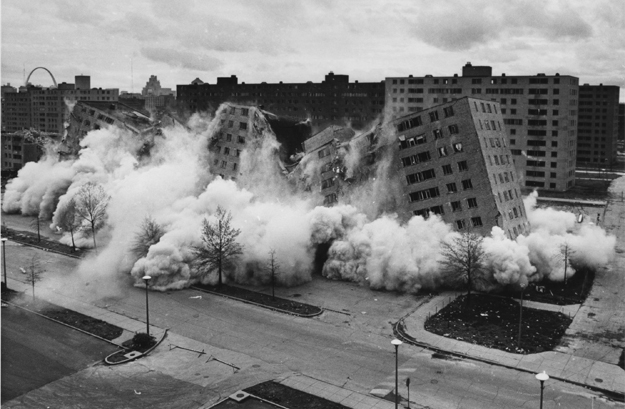

Questioning Catastrophe by Lebbeus Woods

Monday, January 23, 2012

A1: 168 Hour Urban Intervention
Design an intervention that affects others in a positive way.

Building Realities: This intervention asks students to face the difficulties and realities of constructing in the public realm. Where can an intervention take root? What materials, tools, etc. are necessary to facilitate the intervention’s implementation and temporal duration? How does craft come into play? Consider the cohesiveness of your intervention’s craft and assembly.
Understanding Purpose, Users, Impact: What does it mean to construct something that’s explicitly meant to perform a service for people? Is this act different from any other type of architecture? Define the service or purpose of your intervention, the users, and the social impact its aiming to provide.
Represent and Communicate your Intent Effectively: Document your project in an effective manner to convey ideas, intentions, uses, happy accidents, etc. How do certain representation techniques convey certain concepts?
+ Intervention must be documented as having made a positive effect on an existing condition. How do you measure effect?
+ Due to gorilla nature of this project, intervention may be temporary / fleeting.

due in-class on Monday, January 30th, 2012, at 4pm
Design an intervention that affects others in a positive way. This first assignment is purposefully simple, introducing students to the concepts of and relationships between design, urban space, and the social. We will continue to explore these concepts over the course of this semester, building on the intricacies and complexities of these issues.
LEARNING GOALS
Develop Collaboration Skills: For this assignment, you will be working as a group to design, implement, record, and communicate your urban intervention. Learning to engage ideas that are not necessarily your own in a passionate and productive fashion is an invaluable skill for all designers.
Building Realities: This intervention asks students to face the difficulties and realities of constructing in the public realm. Where can an intervention take root? What materials, tools, etc. are necessary to facilitate the intervention’s implementation and temporal duration? How does craft come into play? Consider the cohesiveness of your intervention’s craft and assembly.
Understanding Purpose, Users, Impact: What does it mean to construct something that’s explicitly meant to perform a service for people? Is this act different from any other type of architecture? Define the service or purpose of your intervention, the users, and the social impact its aiming to provide.
Represent and Communicate your Intent Effectively: Document your project in an effective manner to convey ideas, intentions, uses, happy accidents, etc. How do certain representation techniques convey certain concepts?
GUIDELINES
+ Intervention must be physical. You must add material/matter to the urban condition. (Hypothetical / theoretical interventions are not allowed)
+ Intervention must be documented as having made a positive effect on an existing condition. How do you measure effect?
+ Due to gorilla nature of this project, intervention may be temporary / fleeting.
+Potential goal (extra credit!): Include a pedagogical element: Intervention teaches something, engages occupants/users/public through an educational element.
REQUIREMENTS
At minimum you should provide architectural drawings (plans, sections/elevations, perspectives, axons) on (2 minimum) 11x17 pages. Also include process/design sketches, photos, videos, 3d models, etc.
REQUIREMENTS
At minimum you should provide architectural drawings (plans, sections/elevations, perspectives, axons) on (2 minimum) 11x17 pages. Also include process/design sketches, photos, videos, 3d models, etc.
Links
http://encoreheureux.org/
http://www.olafureliasson.net/works.html
More images of interventions
Dowdload PDF of Brief
http://www.olafureliasson.net/works.html
More images of interventions
Dowdload PDF of Brief
Studio Blog!
Welcome to Total [Re]Design, the studio blog. We'd like to use this site to share content and ideas.
DOWNLOAD OUR SYLLABUS
DOWNLOAD OUR SYLLABUS
Subscribe to:
Posts (Atom)